Corner Bead Guide: Calculating Linear Footage and Stick Count

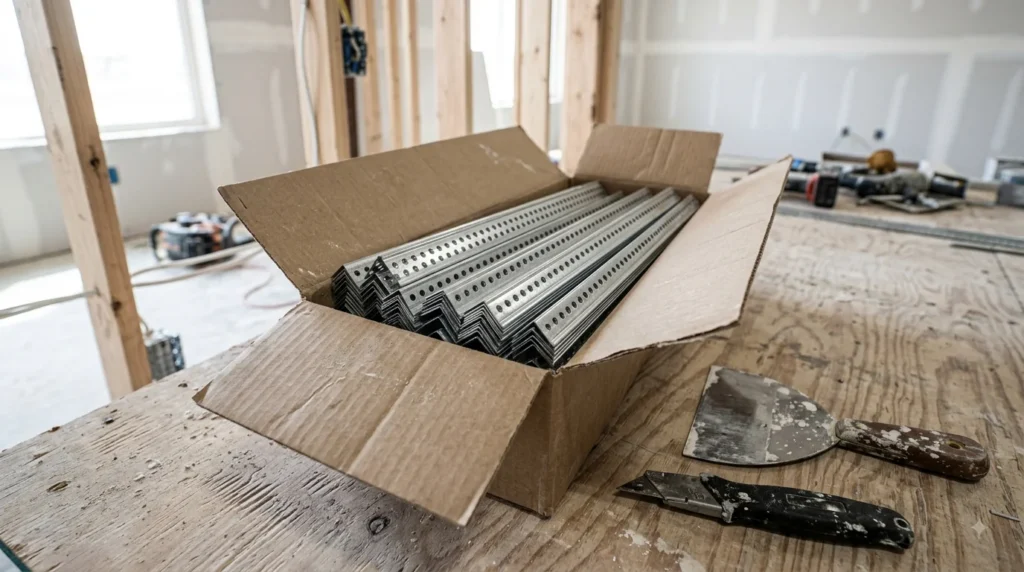
Overhead close-up photo showing an open cardboard box filled with stacks of metal corner bead next to a drywall taping knife and utility knife on a plywood floor.
A supply of corner bead and professional tools laid out on the dusty job site, ready for installation.

Corner bead protects and straightens outside (convex) drywall corners — the edges that stick out into a room, like the corner of a hallway or the edge of a doorway opening. Unlike inside corners, which are simply taped, outside corners need a rigid metal or vinyl bead fastened over the joint before mudding. This guide covers how to calculate exactly how much you need.

Corner Bead vs. Tape

Corner bead is a rigid metal or vinyl strip used on outside (convex) corners to create a straight, durable edge. Paper or mesh tape is used on inside (concave) corners and flat seams, where no rigid support is needed. Any outside (convex) drywall corner needs bead for both durability and a straight finished edge — inside corners do not need bead; they are taped instead.

Calculating Linear Footage

Multiply your outside corner count by the corner height (typically the floor-to-ceiling wall height) to get total linear footage of bead needed. This straightforward multiplication is the base number before waste and stick-length rounding are applied.

Converting to Sticks

Add a waste allowance for trim cuts and mistakes — 10% is a reasonable default — then divide the total by the stick length your supplier sells, most commonly 8 ft or 10 ft, to get a shopping-list number of full sticks, rounding up since bead is not typically field-spliced mid-run on a single corner.

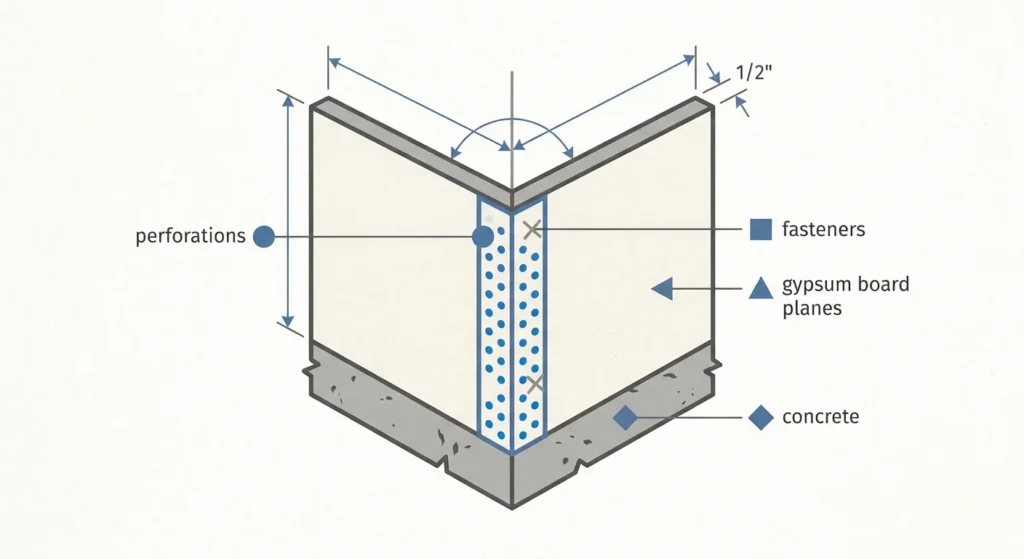
A clean, flat-design technical vector diagram illustrating the layered components of an outside drywall corner: drywall panels, metal bead, and mud layers.
Schematic view showing how the metal bead is embedded beneath successive layers of joint compound to create a perfect edge.

Worked Example

4 outside corners, 8 ft corner height, 10 ft stick length, 10% waste factor.

Linear footage: 4 × 8 = 32 ft.

With waste: 32 × 1.10 = 35.2 ft.

Sticks needed: 35.2 ÷ 10 = 3.52 → round up to 4 sticks.

Common Mistakes to Avoid

  • Applying corner bead to inside corners, which should be taped instead.
  • Not adding a waste allowance for trim cuts at floor and ceiling.
  • Rounding down on stick count instead of up, since bead isn’t typically spliced mid-corner.
  • Using the wrong corner height when a room has varying ceiling heights or sloped ceilings.

Frequently Asked Questions

What is the difference between corner bead and drywall tape?

Corner bead is a rigid metal or vinyl strip used on outside (convex) corners to create a straight, durable edge. Paper or mesh tape is used on inside (concave) corners and flat seams, where no rigid support is needed.

What length does corner bead come in?

Corner bead is most commonly sold in 8 ft and 10 ft lengths, matching standard wall heights, though some suppliers also carry longer stock lengths for commercial work.

Do I need corner bead on every outside corner?

Yes — any outside (convex) drywall corner needs bead for both durability and a straight finished edge. Inside corners do not need bead; they are taped instead.
Try the Corner Bead Calculator

Ready to run your own numbers? Use the free Corner Bead Calculator on our site — just enter your measurements and get an instant, accurate estimate.

[“drywall-corner-bead” calculator here]

Leave a Reply

Your email address will not be published. Required fields are marked *