
How to Calculate Concrete for a Slab: Cubic Yards, Bags, and Waste Factor
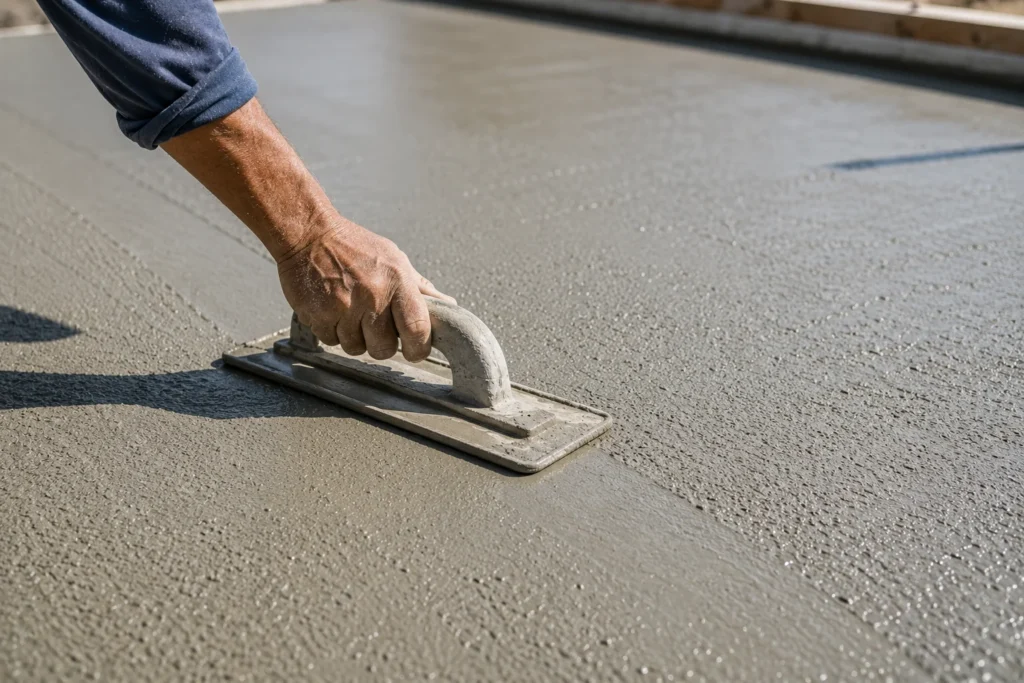
A concrete slab calculation turns three simple measurements — length, width, and thickness — into the cubic yardage you need to order, or the bag count if you’re hand-mixing instead. Getting this number right matters on both ends: order too little and you’ll have a visible cold joint where a second truck picks up mid-pour, and order too much and you’re paying a ready-mix company for wasted yardage that still has to be hauled away. This guide walks through the exact math.
The Core Volume Formula
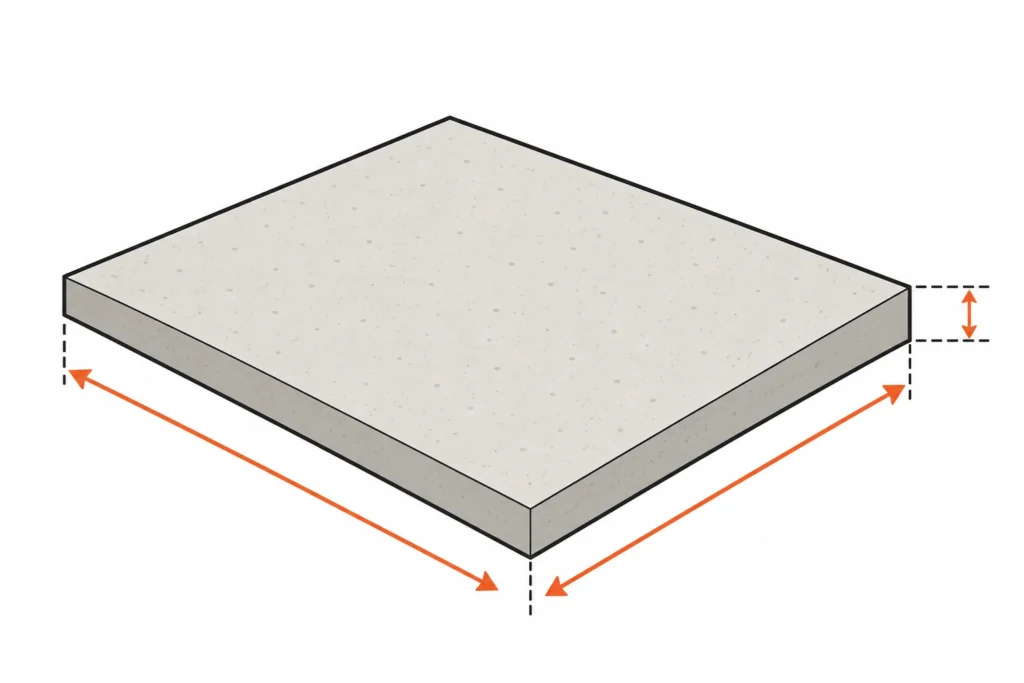
Concrete volume is straightforward geometry: length × width gives you the surface area of the slab, and multiplying that by thickness (converted from inches to feet) gives cubic feet. Since ready-mix concrete is sold and priced by the cubic yard, divide the cubic feet total by 27 (there are 27 cubic feet in a cubic yard) to get the number suppliers actually quote.
Choosing the Right Thickness
Thickness isn’t a fixed number — it depends on what the slab needs to support. Most walkways and patios use 4 inches of concrete, which is adequate for foot traffic and light furniture. Driveways that will carry vehicles should be 5–6 inches, and any area expecting heavy trucks or RVs needs 6–8 inches along with reinforcement.
Why You Always Add a Waste Factor
Real job sites are never perfectly flat, and some concrete inevitably ends up in the wheelbarrow, on the ground, or left in the mixer drum. A waste factor of 5–10% on top of your raw volume calculation accounts for this and is standard practice among concrete contractors — skipping it is one of the most common reasons a pour comes up short.
Converting Cubic Yards to Bags
If you’re hand-mixing with pre-mixed bags instead of ordering a ready-mix truck, one cubic yard needs roughly 60 bags of 60 lb pre-mix or 45 bags of 80 lb pre-mix. This is because a 60 lb bag yields about 0.45 cubic feet of mixed concrete, while an 80 lb bag yields about 0.6 cubic feet — always round bag count up, since a partial bag still requires buying a full one.
Worked Example
A 10 ft × 10 ft patio slab, 4 in thick, with a 10% waste factor.
Surface area: 10 × 10 = 100 sq ft.
Volume in cubic feet: 100 × (4/12) = 33.3 cu ft.
With waste: 33.3 × 1.10 = 36.7 cu ft.
Cubic yards: 36.7 ÷ 27 = 1.36 cu yd — round up to 1.5 cu yd when ordering ready-mix.
Common Mistakes to Avoid
- Forgetting to convert thickness from inches to feet before multiplying by area.
- Skipping the waste factor and coming up short mid-pour.
- Using 4-inch thickness for a driveway that actually needs 5–6 inches for vehicle loads.
- Ordering ready-mix in exact decimal cubic yards instead of rounding up to what the supplier can deliver.
Related Guidence
Frequently Asked Questions
How thick should a concrete slab be?
Most walkways and patios use 4 inches of concrete. Driveways that will carry vehicles should be 5–6 inches, and areas expecting heavy trucks need 6–8 inches with reinforcement.
How many bags of concrete do I need per cubic yard?
One cubic yard needs roughly 60 bags of 60 lb pre-mix or 45 bags of 80 lb pre-mix, since a 60 lb bag yields about 0.45 cubic feet and an 80 lb bag yields about 0.6 cubic feet.
How much waste factor should I add to a slab pour?
5–10% is standard practice, covering uneven sub-grade, spillage, and material left in the mixer or wheelbarrow.
Try the Concrete Slab Calculator
Ready to run your own numbers? Use the free Concrete Slab Calculator on our site — just enter your measurements and get an instant, accurate estimate.
[ “concrete-slab” calculator here]