
Concrete Mix Ratio Guide: Turning 1:2:3 Into Real Quantities
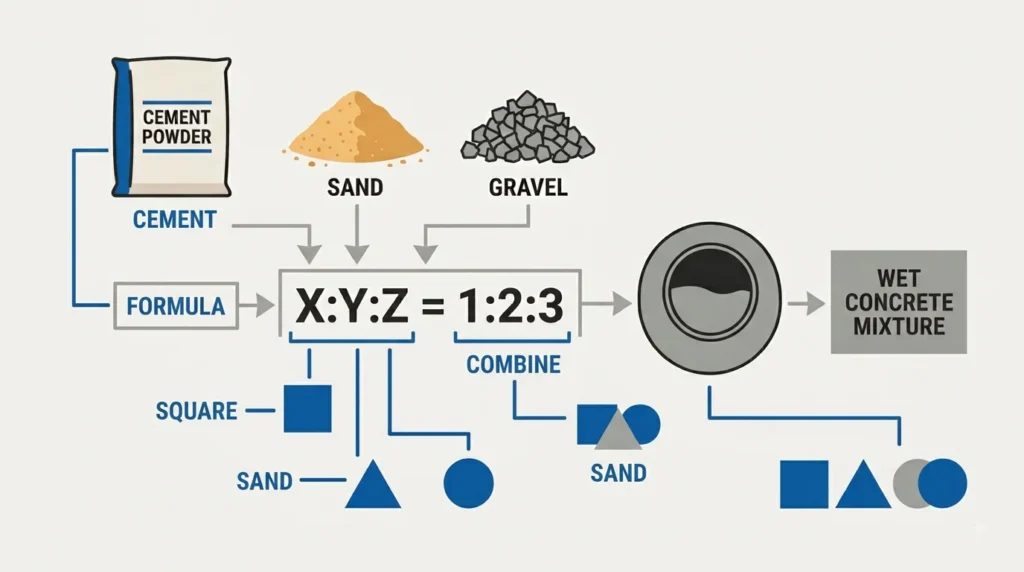
A minimalist flat-design diagram illustrating the 1:2:3 ratio. On an off-white background, geometric grey blocks are arranged horizontally, labeled ‘CEMENT’, ‘SAND’, ‘GRAVEL’, and ‘MIX’ using charcoal text. Charcoal arrows show the flow. Below the inputs, simple mathematical expressions: ‘1 part’, ‘2 parts’, ‘3 parts’. The final output is ‘WET MIX’. Safety orange lines add emphasis to the labels and proportions. The illustration uses minimal line art.
What a Mix Ratio Actually Means
A ratio like 1:2:3 means for every 1 part cement, you use 2 parts sand and 3 parts gravel, by volume. A general-purpose 1:2:3 mix is common for slabs and footings. Richer mixes, with a higher proportion of cement, are used where higher strength is needed, while leaner mixes stretch material further for non-structural fill where strength matters less.
Converting Ratio to Volume
To turn a ratio into real quantities, first add the parts together to get the total number of “shares” — for a 1:2:3 mix, that’s 1 + 2 + 3 = 6 total shares. Then split your total batch volume across cement, sand, and gravel in that same proportion: cement gets 1/6 of the total volume, sand gets 2/6, and gravel gets 3/6.
Converting Cement Volume to Bags
A cubic yard (27 cu ft) split at a 1:2:3 ratio needs about 4.5 cu ft of cement, which works out to roughly 4–5 standard 94 lb bags, since one bag is approximately 1 cubic foot. This is a useful cross-check when you’re hand-mixing rather than ordering pre-batched ready-mix, since it tells you how many bags of straight cement to buy on top of your sand and gravel.
Worked Example
27 cu ft (1 cubic yard) of concrete, at a 1:2:3 ratio.
Total shares: 1 + 2 + 3 = 6.
Cement: (1/6) × 27 = 4.5 cu ft → about 4–5 bags of 94 lb cement.
Sand: (2/6) × 27 = 9 cu ft.
Gravel: (3/6) × 27 = 13.5 cu ft.
Common Mistakes to Avoid
- Treating a mix ratio as a fixed recipe rather than a proportion that scales with total batch volume.
- Forgetting to add the parts together to find total shares before dividing the volume.
- Using a general-purpose 1:2:3 mix for a structural application that calls for a richer, higher-cement mix.
- Not converting cement volume into an actual bag count when shopping for material.
Related Guidence
Frequently Asked Questions
What does a 1:2:3 concrete mix ratio mean?
It means for every 1 part cement, you use 2 parts sand and 3 parts gravel by volume — a general-purpose ratio suitable for most slabs, footings, and foundations.
How many bags of cement does a cubic yard of 1:2:3 mix need?
A cubic yard (27 cu ft) split at a 1:2:3 ratio needs about 4.5 cu ft of cement, which is roughly 4–5 standard 94 lb bags, since one bag is approximately 1 cu ft.
Is a richer mix always better?
Not necessarily — richer mixes with more cement cost more and are meant for applications needing higher strength. General-purpose slabs and footings typically don’t need more cement than a standard 1:2:3 mix provides.
Try the Rebar Calculator
Ready to run your own numbers? Use the free Rebar Calculator on our site — just enter your measurements and get an instant, accurate estimate.
[ “concrete-rebar” calculator here]