
Roofing Cost Guide: How Much Does a New Roof Really Cost?
Once you know how many roofing squares a job covers, total project cost comes down to multiplying that number by regional material and labor rates. But those rates swing widely based on market, shingle grade, roof complexity, and pitch — which is why two roofs of the same size can carry very different price tags. This guide breaks down what actually drives roofing cost so you can build a realistic estimate before calling contractors.
The Two Cost Components: Material and Labor
Total installed roofing cost is generally split into material cost per square (shingles, underlayment, flashing, nails) and labor cost per square (tear-off and installation). Nationally, total installed cost for asphalt shingle roofs typically runs $350–$600 per square, though this varies enormously by region, roof pitch, and how much of the old roof needs to be torn off first.
Material cost alone usually runs $100–$200 per square for standard architectural asphalt shingles, with premium or designer shingles running considerably higher. Labor is the larger, more variable component, often running $150–$400+ per square depending on local labor rates and roof difficulty.
Why Waste Factor Only Applies to Material
A detail that trips up a lot of first-time estimators: waste factor should be applied to material cost only, not labor. Labor is billed per square of finished, installed roof — the crew isn’t paid extra for the cut-off scraps that never made it onto the roof. Material, on the other hand, has to be purchased in the quantity actually used, including the waste from cuts, hips, and ridge caps.
How Roof Pitch Affects Labor Cost
Steep-slope roofs carry a labor surcharge because they’re slower and riskier to work on — crews need additional safety equipment, harnesses, and roof jacks, and simply move more cautiously. Above roughly a 7/12 or 8/12 pitch, expect labor costs to increase 10–20% or more compared to a standard walkable roof.
Tear-off adds another layer of cost. A simple overlay (shingling over an existing single layer) is cheaper than a full tear-off down to the decking, but many jurisdictions cap the number of layers allowed, and a full tear-off is generally the better long-term choice since it lets the installer inspect and repair the decking underneath.
Building a Rough Estimate
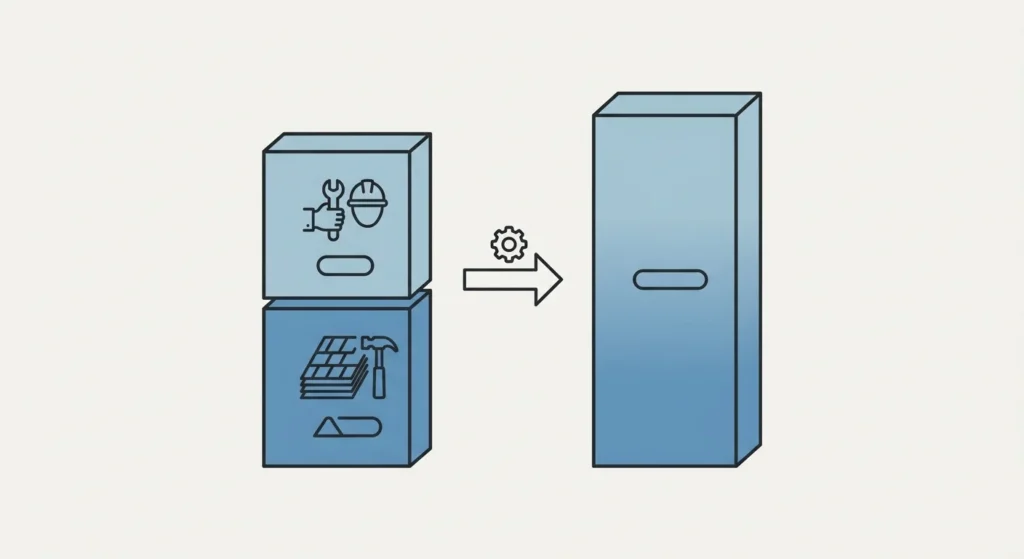
To build a starting estimate: determine your roof’s square count (see the Roofing Shingles guide for that calculation), multiply by your region’s material cost per square, multiply separately by labor cost per square, apply your waste factor to the material total only, then add the two together.
Treat the result as a planning number, not a quote. Actual contractor bids will factor in site access, disposal fees, permit costs, and any decking repairs discovered during tear-off — all of which can shift the final number.
Worked Example
A 20-square roof, $150/square material, $200/square labor, 10% waste factor.
Material with waste: 20 × 1.10 × $150 = $3,300.
Labor (no waste applied): 20 × $200 = $4,000.
Estimated total: $3,300 + $4,000 = $7,300.
Common Mistakes to Avoid
- Applying the waste factor to labor cost as well as material — labor is billed on finished area only.
- Forgetting to add a pitch surcharge for steep roofs when comparing your estimate to contractor bids.
- Not budgeting for potential decking repair costs that only surface once tear-off begins.
- Using national average cost-per-square figures without adjusting for local labor rates.
Related Guidence
Frequently Asked Questions
What is the average cost per square to roof a house?
Total installed cost (material + labor) typically runs $350–$600 per square for asphalt shingles, though this varies widely by region, roof pitch, and how much of the old roof needs tear-off.
Does a steep roof cost more to install?
Yes — steep-slope roofs usually carry a labor surcharge because they’re slower and riskier to work on, often adding 10–20% or more to labor costs above roughly a 7/12 or 8/12 pitch.
Should I budget extra for tear-off?
Yes. Removing existing roofing and disposing of it adds labor and dump fees on top of the installation cost, and if the decking underneath needs repair, that’s an additional line item most estimates don’t include upfront.
Try the Roofing Cost Estimator
Ready to run your own numbers? Use the free Roofing Cost Estimator on our site — just enter your measurements and get an instant, accurate estimate.
[ “roofing-cost” calculator here]